ABSTRACT
The concept of "the people," which lies at the center of debates on populism, is often treated as a pre-existing community. In contrast, this article argues that "the people" is not represented by the populist leader but is rather a political subject constructed step-by-step through discourse. Combining Laclau's discourse theory with a Lacanian psychoanalytic reading, the author establishes an original framework to analyze the four fundamental moments of populism and how different types of crises produce distinct designs of the people.
Focusing on the cases of Trump, Modi, the Five Star Movement in Italy, and Viktor Orbán, the author demonstrates how the same political "grammar" operates in different contexts. Furthermore, the author asserts that the 2026 Hungarian elections reveal these constructed "peoples" to be temporary rather than permanent, showing them to be rebuildable and even dissolvable political formations. Consequently, the author proposes reading populism as a dynamic political process that explains not only the discourse of leaders but how the people are constituted, transformed, and reconstructed, opening a discussion on why this process is vital to understanding contemporary democracies.
I. Introduction
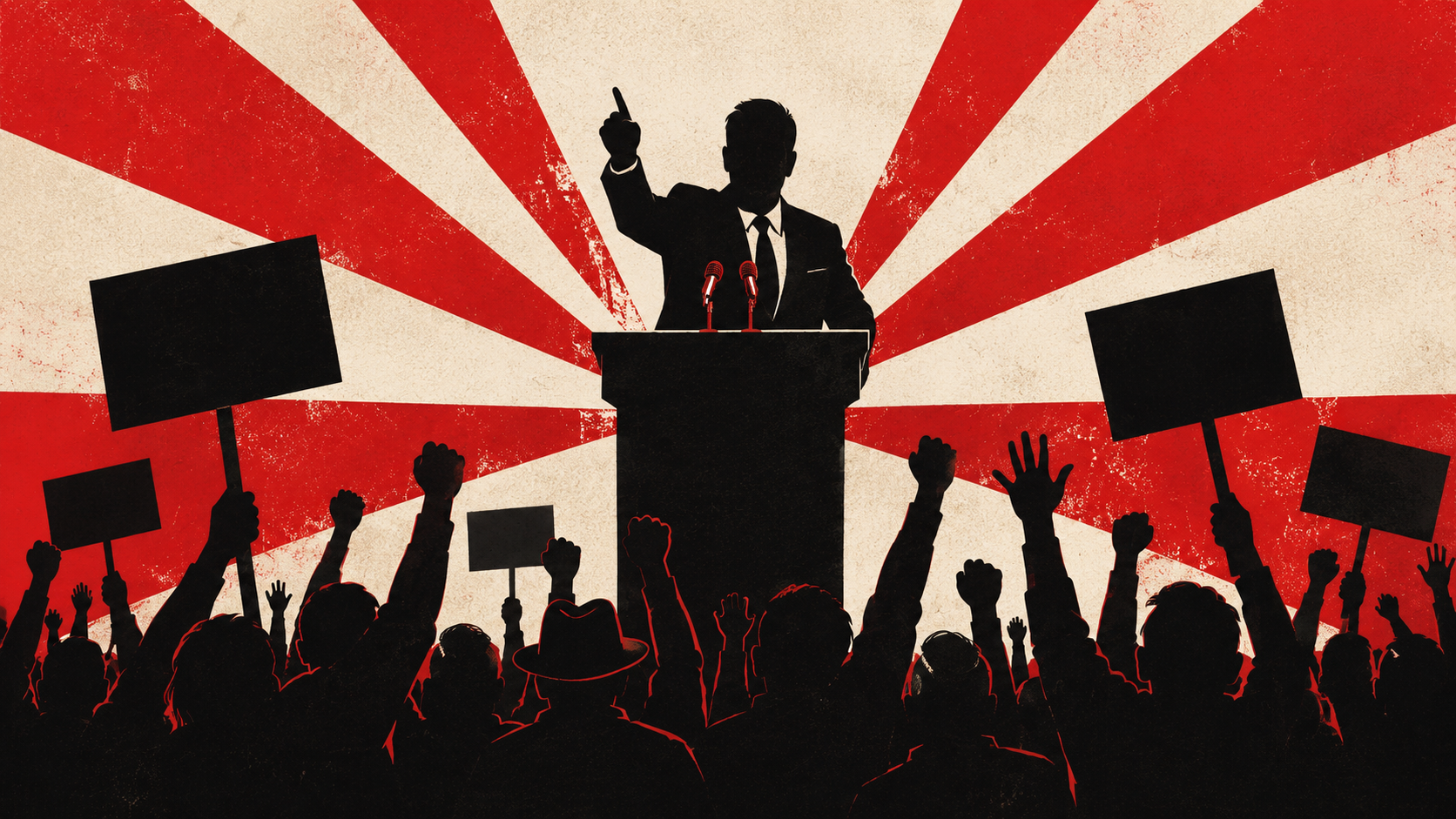
There is one word that never leaves the populist leader's lips: the people. However, this "people" is not a ready-made community standing by, waiting to be represented. The leader does not find them ready; they bring them into existence as they speak. What they do is not to reflect an existing population as it is, but to construct a political subject from scratch.
There are different analytical traditions within the literature on populism. While some researchers view populism as a thin-centered ideology, some as a political strategy, and others as a socio-cultural style, the discursive approach represented by Ernesto Laclau reads it as a logic in which "the people" is constructed within discourse.1 I have previously discussed the framework I built upon four symptoms and three models by combining this analysis of Laclau with a Lacanian reading.2 In this article, I will apply the same framework to four examples selected from three different continents, namely Trump, Modi, Italy’s Five Star Movement, and Orbán. Finally, I will draw a lesson from April 2026: a people brought together can disperse, and may even go on to constitute the people of another leader.
II. The Four Symptoms of Populism
The populist construction of a people unfolds in four successive moments. The process usually begins with a crisis; this crisis manifests sometimes as a war, sometimes as an economic collapse, sometimes as a depletion of trust in political parties, and sometimes as a widespread perception of corruption. What transforms the segment shaken by the crisis into a single "people" are the common symbols that come into play in the second moment. In the third moment, the unfulfilled demands of this people—that is, the thing that is lacking and longed for—come to the fore. The final element completing the picture is the "others": those who are believed to possess, or even to have stolen, the very thing the people are deprived of and desire.
Lacan’s mirror stage lies at the psychoanalytic core of this mechanism. The crisis shatters the old mirror; the segment that had until then considered itself a part of society suddenly scatters like "the body in bits and pieces," feeling disconnected from the rest and thoroughly fragmented. The leader steps in at this exact moment and holds up a mirror to this segment: through their discourse, they show them who they are, more importantly who they could be, and even what they should desire. This gesture is reminiscent of a mother holding her baby by the hands in front of a mirror, standing them up and playing with them as if they are walking. The mother shows her still-crawling baby an upright, whole, and mobile body in the mirror; by displaying the child's potential before their eyes, she fills them with excitement. Similarly, the leader presents a smooth and whole image of a "people" to the scattered crowd by leaning on the symbols of a class, a religion, or a tradition. The "I" is born in that very moment, and the crowd becomes a "people" right then.
However, this image is not yet real. The baby indeed sees a whole body in the mirror, but they have not yet grown that much, nor achieved that wholeness; in between, a lack remains, waiting to be closed. The same applies to the people: the promised wholeness is never in the present, but always one step ahead. At this point, an inevitable question arises: if we are whole, but not quite at the level we wish to be, who is responsible for this lack? Populism has a ready answer for this; the blame for the lack is pinned on an "other," because it is they who usurp the people's rights, steal their happiness, and prevent them from becoming complete. That unattainable wholeness, which psychoanalysis calls objet petit a, mobilizes both desire and action; the leader reveals the name of the thief, and from them, the people learn to believe that the other has confiscated their happiness.3
III. The Type of Crisis, The Type of People
The nature of the crisis also determines the nature of the people to be constructed. If the crisis is economic, what is desired is prosperity; in this case, the people consist of those oppressed by the system, while the opposing "other" is the wealthy and the establishment itself. If the crisis is political, what is desired is representation; the people are composed of ordinary citizens, while the "other" consists of the elites and the established cadres. If the crisis is cultural, what is desired is unity and purity; this time, the people are made up of "natives," while the "other" consists of foreigners, immigrants, and those believed to have infiltrated the country. In real-world examples, leaders are often seen intertwining these three patterns.
IV. The Same Grammar, Four Peoples
It is possible to observe the same grammar in four recent examples and across all three models simultaneously.4
The first example of this grammar is Trump. His people gather around the segments left behind by industrial decline; closed factories, lost jobs, and wounded pride constitute the common story of this people. The symbol used is both ready-made and empty: Make America Great Again. What fills this phrase is a lost greatness, and what is desired is the return of that greatness. The culprits lined up are clear: immigrants, China, coastal elites, and the "deep state." By adding the third model to this picture, Trump draws the line that separates the real American from the outsider, and presents himself as the man who speaks the truth that the others have silenced. The pleasure this attitude gives him is often the thrill of transgressing the prohibition; indeed, this attitude is closely related to that unruly, ostentatious flair that the approach reading populism as a socio-cultural style terms “low.”5
Modi’s people, on the other hand, is the Hindu nation; since the crisis here is cultural, it falls under the third model, and what is desired is unity and purity. Hindus from different castes and classes are gathered under the roof of a common belonging; the invoked symbols are derived from the glorious past of a civilization believed to have been wounded. On the other side of the line are Muslims, the dilapidated dynastic opposition, those branded as "enemies of the nation," and Western critics. The promise is the reintegration of a civilization believed to have once been great but subsequently despised; Modi shows his people the state of being "united, formidable, and vigorous." Like the mother in front of the mirror, he personally tells the people what they are and what they should be.6
The plainest example of the second model comes from Italy, from the Five Star Movement founded by Beppe Grillo in 2009. The crisis here is neither cultural nor economic; it is entirely political. Endless corruption scandals, discredited parties, and a mass of voters who consider themselves unrepresented feed this crisis; therefore, what is desired is straightforwardly representation. Grillo brings the people together around the "honest, ordinary citizen"; the common symbol is the rejection of the right-left divide and the promise of direct democracy. The phrase "opening parliament like a can of tuna" turns into the slogan of this promise. A single "other" is placed across the line: la casta, or the caste, which depicts the entire political class as a privileged clique usurping the citizens' rights. Here, neither economic grievance nor national purity comes to the fore; what is decisive is the moral opposition between the corrupt ruling clique above and the honorable people below. The leader tells this crowd, which sees itself as unrepresented, that they are the true people, and that it is this caste that is robbing them.7
Orbán, too, operated the same cultural model for sixteen years. His people were the "Hungarian" and "Christian Europe," and his symbols were national sovereignty and "illiberal democracy"; on the other side of the line, he placed Brussels, Soros, the immigrant, and civil society. His promise was the defense of the very essence of a small, besieged nation, and he took it upon himself to be the guardian of this essence. After every election he won, he took the mirror a little more into his own hands; he rewrote the constitution, weakened the judiciary, and left the media to pro-government capital groups. Then, this construct was tested on the ground in 2026.8
V. 2026: When the Constructed People Disperses
On April 12, 2026, Orbán’s sixteen-year rule came to an end. Péter Magyar’s center-right Tisza Party received approximately 53 percent of the votes and won 141 seats in the 199-seat parliament, surpassing the two-thirds threshold of 133 seats. The turnout, at 79.6 percent, was the highest of all free elections held since 1990. Orbán described the result as “clear and bitter.”9
What truly matters is this: Magyar defeated his rival not with facts, but by constructing a separate people. Moreover, he did this largely using Orbán’s own playbook; national flags, a patriotic language, and the masterful use of social media were his tools as well. The difference was that he replaced fear-based populism with the fight against corruption and a return to Europe. As a figure coming from the very inside of the system but having irreversibly broken away from it, he single-handedly overcame the credibility barrier that the opposition had been unable to surpass for years, and gathered the urban and the rural under the same roof. In short, he held up a different mirror.
What shattered the old mirror was the confluence of a few familiar factors. Frozen European Union funds had made the economy unsustainable, leaks that spilled out a few days before the election tied Budapest to Moscow, and overt political support from the outside backfired. Thus, the two veins that Orbán had fed on for sixteen years—namely, low turnout and a fragmented opposition—dried up simultaneously.
And this was precisely the crucial argument of the framework: a constructed people is contingent, and what is contingent is reversible. When the mirror shatters, that whole image dissipates, and the people, losing their sense of wholeness, regress to a fragmented state (the body in bits and pieces); the fragments there can very well reunite in a new mirror held by another leader, becoming a new unity, a new wholeness. As long as this is done not with fact, but with a better fiction—that is, with another mirror. Hungary 2026 has shown that populism is not invincible; for the people it constructs is not a primordial given, but something constructed later.
VI. In Lieu of a Conclusion: What Can We Draw From This?
Two conclusions can be drawn from this picture. The first concerns analysis: since the people are not a ready-made mass measurable by polls, and are indeed constructed subsequently, anyone wishing to understand them must look at which crisis, which common symbols, which unfulfilled demand, and which dividing line have converged. Otherwise, the leader is reduced to personal charisma, the voter to a passive mass, and the actual mechanism is overlooked.
The second conclusion concerns politics. An exclusionary populism cannot be countered by fact-checking alone; because the image in the mirror is not a claim of fact, but a mechanism of desire, and one cannot keep statistics on a wound. The only response that works is a rival fiction: a counter-narrative that tells of the same wound in its own language, but proposes a broader and more inclusive "we." Hungary 2026 is a tangible example of this.
Let us conclude with a final warning. The grammar—that is, the discourse itself—is not under anyone's monopoly. The counter-narrative can very well be populist too. Indeed, Magyar also won through a national language, an anti-corruption and pro-European populism, and moreover, by borrowing his rival's tools. Furthermore, that two-thirds majority sufficient to rewrite the constitution is in Magyar’s hands today. Magyar’s mirror was able to reflect society as a whole once again. Thus, what is truly decisive is where the line is drawn and who is left out. For essentially every leader wants to construct the people from scratch; the real difference emerges in whom the leader convinces to enter the reflection of their mirror.
Notes
1. For the main approaches in the populism literature, see Cas Mudde, “Populism: An Ideational Approach”; Kurt Weyland, “Populism: A Political-Strategic Approach”; Pierre Ostiguy, “Populism: A Socio-Cultural Approach”; all in The Oxford Handbook of Populism, ed. Cristóbal Rovira Kaltwasser et al. (Oxford University Press, 2017). For a critical evaluation of the discursive approach, see Enrique Peruzzotti, “Laclau’s Theory of Populism: A Critical Review”, in Routledge Handbook of Global Populism, ed. Carlos de la Torre (Routledge, 2019).
2. For the framework based on the four symptoms, three models, and the mirror stage, see Şakir Dinçşahin, “Populism of Religious Conservative Parties in Turkey: A Psychoanalytical Approach”, Eklektik Sosyal Bilimler Dergisi 1, no. 1 (2023): 127-170; and “A Symptomatic Analysis of the Justice and Development Party’s Populism in Turkey, 2007-2010”, Government and Opposition 47, no. 4 (2012): 618-640.
3. For the empty signifier, chain of equivalence, and antagonistic frontier, see Ernesto Laclau, On Populist Reason (Verso, 2007). For the mirror stage, the illusion of unity, and objet petit a, see Jane Gallop, “Lacan’s ‘Mirror Stage’: Where to Begin”, SubStance 12, no. 1 (1983): 118-128; Sean Homer, Jacques Lacan (Routledge, 2005).
4. Donald Trump assumed his second presidential term in January 2025, and Narendra Modi his third prime ministerial term in 2024; Viktor Orbán served continuously as prime minister from 2010 to 2026.
5. For the reading of populism through the "high" and "low" axis, see Pierre Ostiguy, “Populism: A Socio-Cultural Approach”, in The Oxford Handbook of Populism. For the United States example, see Joseph Lowndes, “Populism in the United States”, in the same volume.
6. For the India example, see Christophe Jaffrelot and Louise Tillin, “Populism in India”, in The Oxford Handbook of Populism.
7. For the moral opposition between the "morally pure people" and the "corrupt elite", see Cas Mudde, op. cit. For the concept of "la casta", see Gian Antonio Stella and Sergio Rizzo, La Casta (Rizzoli, 2007). The Five Star Movement was founded by Beppe Grillo in 2009 and became Italy's largest party in the 2018 general elections.
8. For the relationship between populism, migration, and xenophobia in Europe, see Carlo Ruzza, “Populism, Migration, and Xenophobia in Europe”, in Routledge Handbook of Global Populism.
9. In the Hungarian parliamentary elections of April 12, 2026, the Tisza Party led by Péter Magyar won 141 seats in the 199-seat parliament, attaining the two-thirds majority (the 133-seat threshold) necessary to amend the constitution, and put an end to Orbán's sixteen-year rule; Fidesz was left with 52 seats, and the turnout was the highest since 1990 at 79.6 percent. Sources place Tisza's vote share at around 53 percent. See data from Al Jazeera, Reuters, and the Hungarian National Election Office.