
Recent Examples of Rendering the Grand National Assembly of Türkiye Dysfunctional: Internal Regulations, Political Ethics, and the Test of Democracy
ABSTRACT
This article reveals that the Grand National Assembly of Türkiye (TBMM) has been increasingly rendered ineffective, not only due to the restriction of its constitutional powers—especially with the post-2017 Constitutional amendments—but also because of controversial interpretations of the internal regulations and practices incompatible with political ethics. The recent contradictions between commissions and the general assembly, as well as the debates over fake voting ballots, further deepen concerns regarding the political ethics dimension and democratic legitimacy of legislative activities.
Numerous critical research reports, articles, and analyses have previously been published by the Center for Public Policy, State Administration, and Societal Progress (KAPDEM) regarding the "Presidential Government System" established by the post-2017 Constitutional amendments, alongside the structural and functional problems of the newly established political and administrative order. Without repeating the important points stated in those previous studies, this article re-analyzes how the weakening of the TBMM's oversight and legislative power following the transition to the Presidential Government System has been further exacerbated by such practices, pointing to recent examples.
It is underlined and emphasized that the erosion of the will of the TBMM, which is the fundamental guarantee of a democratic state governed by the rule of law, damages not only the opposition's right to speak but also national sovereignty. Furthermore, by recalling the historical and founding role of the TBMM, a call is made to restore and strengthen the prestige and effectiveness of the Parliament on the basis of political ethics and the principles of the rule of law.
Recent Examples of Rendering the Grand National Assembly of Türkiye Dysfunctional: Internal Regulations, Political Ethics, and the Test of Democracy
1. Introduction
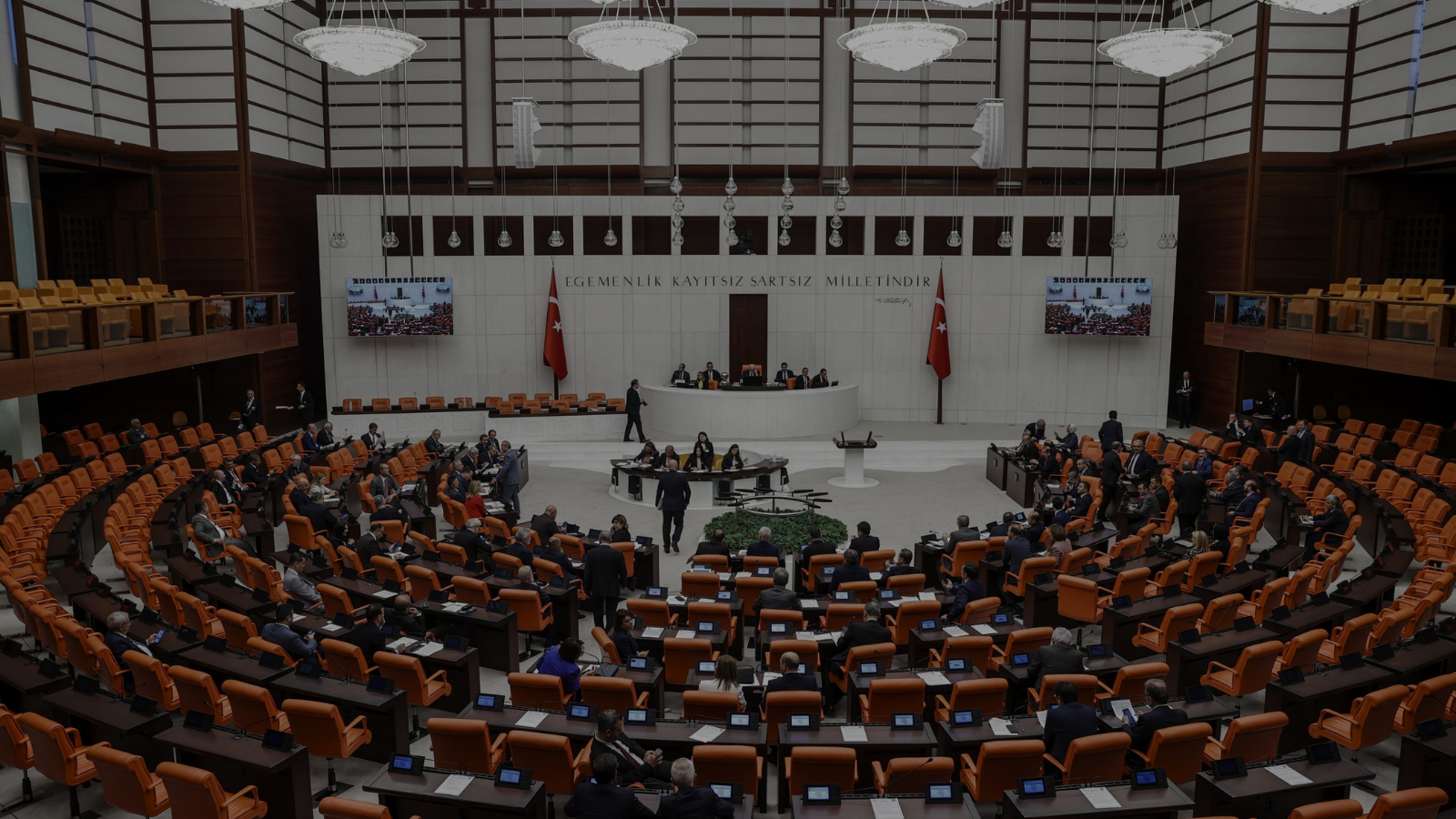
The incident that recently took place in the General Assembly of the Grand National Assembly of Turkey (TBMM) has taken the criticisms of "TBMM's dysfunctionality"—which have been a constant topic of debate since the latest Constitutional amendments—to a new and highly controversial dimension. The incident was as follows:
In the last days of July, while one of those "omnibus bills" was being discussed in the TBMM General Assembly, various amendment motions submitted by opposition MPs were first "accepted" by the Commission Members belonging to the ruling party majority, but immediately afterward, they were rejected by the General Assembly, which also consists of the ruling party majority.
This situation was, of course, bizarre. Because the same ruling party majority, in the exact same session, was saying "yes" as Commission Members and "no" as General Assembly members. Since the General Assembly has the final word, the opposition's amendment proposals were ultimately not being accepted.
Well then, why was this "legislative cunning" being employed? Here is why:
You see, Article 87 of the TBMM Internal Regulations, which regulates the discussion of amendment motions on draft laws and proposals, states: "The owners of the motion may make explanations not exceeding 5 minutes regarding the amendment motions that the Commission does not agree with."[1]
In other words, this article does not contain a provision allowing the owners of amendment motions that the Commission "agrees with" to speak about their motions.
Consequently, the ruling party majority was taking advantage of this wording. By stating that they "agreed" with the amendment proposals, they were blocking the opposition MP—the owner of the proposal—from speaking for even just 5 minutes to explain "why they proposed this amendment."
2. Internal Regulations and Political Ethics
It is certainly possible to criticize the way Article 87 of the TBMM Internal Regulations is written. Because if someone makes a proposal to you, whether you like it at first glance or not, you would want to hear an explanation from them. After all, you would think, "This proposal is fine and good, but let's hear the reasoning from their own mouth!" Even between individuals, the logical process of social relationships progresses this way. Moreover, if an amendment is being proposed regarding a legal article that concerns the entire country, it is everyone's right to know the reason. Since draft laws and proposals are already required to be written "with justification"; can the justification for the amendment motions regarding them be hidden from the MPs who have not yet voted to accept or reject that amendment (and whose vote is not yet clear)? Wouldn't such a situation mean restricting the "Parliament's law-making power"?
Looking at it this way, it is indisputably evident that Article 87 of the Internal Regulations is incomplete and flawed in this regard. It urgently needs to be amended.
Another detail in the incident is this: The Internal Regulations grant the right to speak to the MP whose amendment proposal is not accepted by the commission, yes; but it does not say that the MP whose proposal is accepted by the commission "cannot speak." That is to say, there is no obstacle preventing the speaker chairing the TBMM session from granting that MP the opportunity to speak!
It is evident that under the management of a session chair "who consents to the voicing of opposing views," this loophole left by the Internal Regulations might not have caused a problem. But that was not the case.
The Internal Regulations are insufficient, the attitude of the session chair is wrong, yes; but there is a much graver point in this incident: Political ethics!
Think about it: A ruling party MP, as a Member working on that draft law in the Specialized Commission, "accepts" the amendment motion submitted by the opposition in the General Assembly; but immediately afterward, not even 10 minutes later, says "no" this time as a General Assembly member! Isn't this clear and definitively conflicting attitude "problematic" in terms of political ethics?
It certainly is problematic. Because we learn that the ruling party MPs who maintained this attitude for a while eventually abandoned their stance following the ethical debates in the General Assembly and (fortunately) ceased to continue this practice in subsequent amendment proposals.
3. The Presidential Government System and the Effectiveness of the Grand National Assembly of Türkiye
As we all know by now, Turkey transitioned to a "presidential-like" system with the Constitutional amendments made in 2017. In fact, this process, which began in 2014—following the 2007 Constitutional amendment—when the President, previously elected by the Grand National Assembly of Turkey (TBMM), was elected by the public for the first time, took its final shape with the 2017 Constitutional amendments and was fully implemented with the parliamentary and presidential elections held concurrently on June 24, 2018.[2],[3]
The primary distinguishing feature of this new governance model, referred to in the literature as the "Presidential Government System," is that it made a radical change to the traditional "executive" method that Turkey had been implementing since the 1924 Constitution, bypassing the "council of ministers" and granting executive authority and duties solely to the President.[4]
Thus, the president, who had traditionally been a "check and balance authority not bearing responsibility in terms of administrative duties but granted many discretionary and approval powers," was endowed solely with the combined powers of the "council of ministers + president," that is, with "full executive power" in this new era.
One of the consequences of the Constitutional amendment was that many powers we were traditionally accustomed to being exercised by the TBMM began to be exercised solely by the president; the other was that many oversight powers the TBMM possessed over the actions and procedures of the council of ministers were either completely eliminated or extraordinarily restricted.
The restrictions that the new governance model has created in the powers and duties of the TBMM, which form the subject of this article, can be briefly summarized as follows:
The President can issue "decrees" on many subjects, thus exercising an administrative regulatory power completely autonomous from the TBMM.
No oversight authority over the decrees issued by the President has been granted to the TBMM. The judicial review of Presidential Decrees has been left to the Constitutional Court.
The President has been granted the authority to renew TBMM elections (along with the Presidential election).
The TBMM's authority to oversee the council of ministers (now appointed by the President) and individual ministers has been abolished.
Methods embodying the TBMM's oversight authority, such as motions of censure (interpellation) and parliamentary investigations, have been abolished. The questioning method has been restricted to only written questions directed to the vice presidents and ministers. It is not possible to address a question to the President.
The "parliamentary investigation" method, one of the TBMM's most effective oversight mechanisms, has been made extraordinarily difficult.
The "legislative" power of the TBMM, whose "authority to oversee the executive" is already heavily restricted constitutionally, is being completely pruned away by forced interpretations of internal regulations and unethical political obstructions, like the ones forming the subject of our article.
4. That is Not All
Unfortunately, the attitudes aimed at narrowing and even blocking the powers and duties of the Grand National Assembly of Turkey (TBMM) are not limited to the forced interpretations of the Internal Regulations we have tried to explain above.
The "fake signed ballot paper scandal" that occurred recently in the General Assembly is still fresh in memory.
During the voting for an international agreement in the TBMM General Assembly session dated June 19, 2026, it was understood that votes were cast on behalf of ruling party MPs who were not actually in the hall. The number of fraudulently signed ballot papers submitted was stated as 79 in various declarations.[5]
The submission of fake signed ballots on behalf of MPs not present in the General Assembly has been repeated in the past as well. Another known example took place in early January 2017, where debates arose over fake ballots submitted to the Chairmanship on behalf of 6 ruling party MPs who were not in the hall.[6]
5. In Lieu of a Conclusion: Final Word
Especially with the latest Constitutional amendments after 2017, we have been experiencing severe erosions in internationally accepted democratic standards.
The Grand National Assembly of Turkey (TBMM) is passing through a period where it is "least effective" in the history of our Republic. While its Legislative and Executive effectiveness is already constitutionally diminished in this manner, compounding this with certain internal regulation and bylaw coercions and unethical political attitudes is unacceptable.
We must not forget: The TBMM is our most valuable asset that organically connects our country with the modern and contemporary world and keeps us at a respectable position in the international arena.
We must also not forget: The TBMM is the headquarters of Turkey's Struggle for Independence and the founding will of our Republic. In the future, when we face similar dangers, our only pillar of support will once again and always be the TBMM.
Showing respect to the TBMM and its will is the indispensable primary duty of our entire nation, without distinguishing between the ruling party and the opposition, and those who will make this visible are the Members of Parliament elected and sent under the roof of the TBMM by our people.
For this reason, restricting the legislative and executive will of the TBMM, especially attempting to do so with certain regulation coercions and unethical attitudes, is the conduct least befitting the representatives of the nation. This urgently needs to be brought to an end.
REFERENCES
[1] TBMM Internal Regulations Art. 87- "(Relevant section)... The Chair asks the commission whether it agrees with the motion. The commission may briefly explain its reason for not agreeing. A motion the commission does not agree with may be explained by its owner for no longer than five minutes."
[2] As a result of the approval of Law No. 5678, passed by the TBMM on May 31, 2007, and published in the Official Gazette dated June 16, 2007, No. 26554, via public referendum on October 21, 2007, the first popular election of the President took place on August 10, 2014. The main changes occurred upon the approval of the "Law on Amending the Constitution of the Republic of Turkey," Law No. 6771, passed by the TBMM on January 21, 2017, and published in the Official Gazette No. 29976 dated February 11, 2017, in the Constitutional Referendum on April 16, 2017. In accordance with the detailed provisions in the "Enforcement" article of the law, following the Presidential and Parliamentary General Elections held concurrently on June 24, 2018, the governance system in Turkey is now called the "Presidential Government System."
[3] https://www.kapdem.org/yeni-anayasa-tartismalari-ne-kadar-gercek-ne-kadar-gerekli
[4] The 1924 Constitution (Teşkilat-ı Esasiye Kanunu) No. 491, adopted on April 20, 1924, replaced the "parliamentary government" system of the 1921 Constitution with a "council of ministers accountable to the parliament," and this system was preserved in all constitutions until the 2017 amendments.
[5] On June 19, 2026, during the voting on an energy agreement signed with Saudi Arabia, the submission of ballot papers on behalf of ruling party MPs who were not present in the hall caused controversy. During a roll call requested by the opposition and conducted by Deputy Speaker Pervin Buldan, who read the names one by one, it was observed that the ruling party MPs on whose behalf ballots were submitted were not in the General Assembly. When a quorum could not be reached in the vote held after the ballot check, the parliamentary session was closed. https://ankahaber.net/haber/tbmm-genel-kurulu-nda-iktidar-siralarindan-verilen-pusulalardaki-vekiller-salonda-bulunamadi-5074b3cd
[6] https://www.tbmm.gov.tr/milletvekili/UyeGenelKurulKonusmalariDetay?eid=58993