

Economy on the Chessboard: The "Check" Threat to the Turkish Economy
I. Introduction
We are on a chessboard. And Türkiye is right at the center of the game. Moreover, it is under the threat of a ‘check’ at any moment. Iraq, Syria, and now Iran-Israel... Every new crisis requires a new move, but which move would save us from being ‘checkmated?’
II. Geography of the ‘Checks’
Türkiye stands on a critical square on the geopolitical chessboard. Over the past two decades, Türkiye has suffered significant economic impacts due to the wars experienced by its border neighbors. In this context, with the Iraq war in 2003 and the Syrian civil war that started in 2011, the Turkish economy was ‘checked’ in a sense due to the millions of migrant movements, the deteriorating trade balances, the negative effects of increasing oil prices and decreasing tourism revenues on the balance of payments, as well as the disruptions caused by the unilateral provision of border security and the economic burdens caused by terrorism.
Considering the geopolitical conditions we are in, none of the countries in the region are immune from the effects of the negative economic conditions caused by these political developments. As a matter of fact, Türkiye was affected by these wars in different ways.
On the other hand, Israel’s attack against Iran with the June 13 operation once again showed that every country on this chessboard can be under the threat of a ‘check’ with a new move at any moment.
However, our previous experiences give us clues about what we can do to avoid our economy from being ‘checkmated’ in this new period, which is not yet clear how long it will take and in what direction it will evolve.
III. Iraq War: Castling (Strategic Positioning)
While Türkiye was in the process of getting out of a deep economic crisis, the March 1 Memorandum was not passed by the Parliament and political tensions rose. With the US intervention in Iraq, regional risks increased and the process that resulted in the collapse of the Saddam regime had multidimensional but generally negative effects on the Turkish economy, both direct and indirect, short and long term.
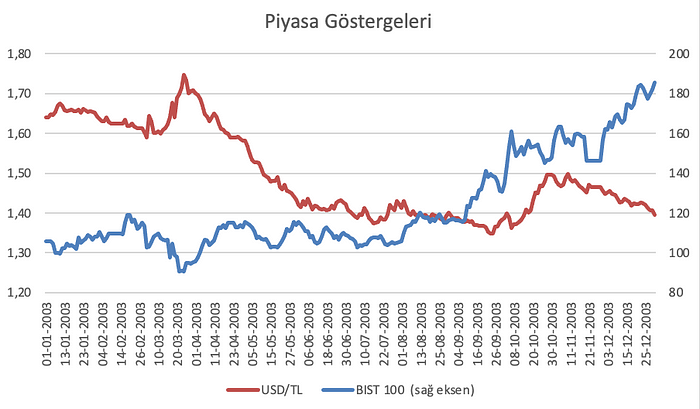
Source: Central Bank of the Republic of Türkiye (CBRT) Data Showing Market Indicators (BIST 100 Right Axis) [Visualized by Dr. M. Coşkun Cangöz]
That’s because Türkiye, which was struggling with a deep economic crisis at that time with the effect of the embargoes imposed before the war, almost completely lost the Iraqi market, one of its largest export markets. During this period, Turkish contractors not only lost their contracting works, but also could not collect their receivables. In addition, billions of dollars of revenue were lost from the Kirkuk-Yumurtalık oil pipeline. The increase in oil prices due to the embargo and the war had a negative impact on Türkiye’s balance of payments. According to estimates, Türkiye’s total loss was around 30-40 billion dollars.
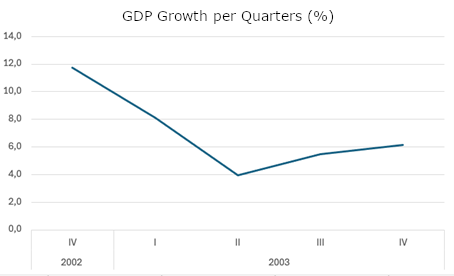
Source: Presidency of Strategy and Budget (Visualized by Dr. M. Coşkun Cangöz)
The uncertainty created by the Iraq War caused concerns in the economic course and the fluctuations in the financial markets negatively affected producer, consumer and investor confidence. However, Türkiye entered this storm with an economic program supported by structural reforms after the 2001 crisis. In this context, with the policies implemented with a ‘castling move’ under the conditions at the beginning of the war, stability in the financial markets was ensured and necessary steps were taken to increase confidence in the economy. With the effect of the short duration of the Iraq War, the Turkish lira strengthened against foreign currencies except for the first quarter of 2003, and positive developments in inflation had a positive effect on expectations and caused interest rates to decline.
Thus, the economic management achieved stability through a determined anti-inflation policy and strong fiscal discipline and the determination of structural reforms. Moreover, the 5 percent growth and 20 percent inflation targets set for 2003 were also achieved.
The moral of the story: Geopolitical risks can be balanced with reforms and decisive fiscal and monetary policies.
IV. Syrian Civil War: Patzer Move (Tactical Game)
The Iraq war had short-lived and controllable effects. However, the Syrian crisis has imposed a significant burden on Türkiye both economically and socially. This was largely the result of a tactical game plan that prioritized short-term gains on the chessboard.
In this process, an important trade route of Türkiye to the Middle East was closed with the civil war. Therefore, not only direct trade with Syria has been hit hard, but also exports to Jordan, Saudi Arabia and the Gulf countries through Syria. Especially provinces such as Kilis, Gaziantep, Hatay and Mardin, which are located near the Syrian border, suffered great economic losses due to the cessation of border trade and security concerns.
The basic needs of millions of Syrian refugees who fled the war and came to Türkiye, such as shelter, food, health and education, increased the pressure on public services. In addition, uncertainty and geopolitical risks have become permanent due to the long duration of the war, increasing security risks on the Syrian border, cross-border operations, and counter-terrorism activities have significantly increased Türkiye’s defense and security expenditures. This situation also created significant burdens on the budget and the primary balance of the budget deteriorated permanently.
Migration has also had devastating effects on the Turkish labor market. While the employment of asylum seekers, especially in sectors that require unskilled labor (with this being done mostly informally), provides cost advantages for some businesses, it also brings unemployment concerns and real wage losses among the local workforce.
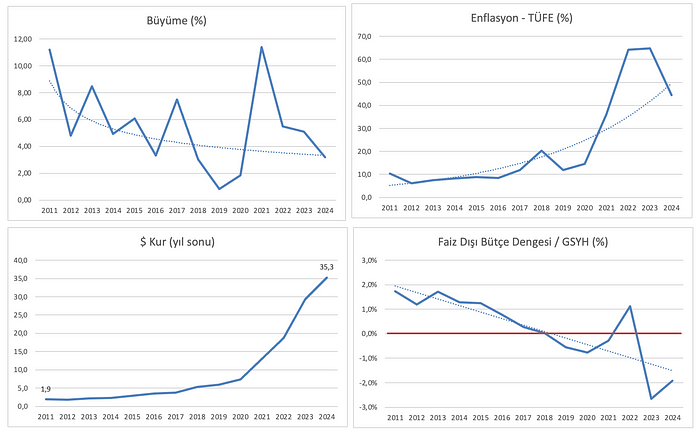
Top-Left Graph: Growth (%), Top-Right Graph: Inflation – CPI (%), Lower-Left Graph: USD Exchange Rate (Year-End), Lower-Right Graph: Primary Balance / GDP (%)
Source: CBRT, Turkish Statistical Institute (TUIK), Ministry of Treasury and Finance (MTF) [Visualized by Dr. M. Coşkun Cangöz]
In addition to the negative effects of the Syrian civil war on the economy, domestic political fluctuations such as the failed coup attempt in Türkiye and the implementation of unorthodox economic policies with the "Patzer move" after the administrative system change increased the fragility of the economic structure. As a result of this process, while Türkiye’s risk premium increased, the Turkish Lira experienced significant depreciation against foreign currency. Exchange rate hikes and unfavorable inflation expectations contributed to deterioration in pricing behavior and fueled inflation.
The moral of the story: Tactical moves can create a ‘check’ threat for yourself.
V. Iran-Israel Crisis: Risk of Stalemate
The process that began with Israel’s attack on Iran on June 13 represents concerns about Iran’s nuclear program and the transition to a new and more dangerous phase of the decades-long regional power struggle between the two countries. The escalation of tensions between Israel and Iran poses significant economic risks for Türkiye. So much so that tactical moves that can be made in the face of changing external conditions may create the risk of facing dilemmas on the geopolitical chessboard.
i. Oil and natural gas prices: The price of oil rose sharply above $73 due to concerns that Iran’s oil exports could be disrupted. This development, which will negatively affect the current account deficit by directly increasing Türkiye’s energy bill, may cause oil prices to rise even more and the bill to increase along with it, especially if scenarios such as the closure of the Strait of Hormuz come true.
ii. Inflation: If rising energy costs put upward pressure on inflation, expectations may be disrupted and program targets may be at risk. Under these conditions, we may see that the Central Bank postpones the interest rate cut decisions expected in the coming months.
iii. Exports: The Israel-Iran conflict is not expected to cause a contraction in the export market, similar to the Iraq war and the Syrian civil war, as Türkiye’s trade with Iran is already limited due to US sanctions on Iran and trade with Israel was halted in May 2024 due to the Gaza war.
iv. Financial markets: Despite the start of the weekend after the initiation of the conflict, the stock market index fell from 9500 to 9100 in the first phase, while the exchange rate increased slightly and the ounce price of gold rose from 3300 to 3400. The extent of volatility in financial markets will depend on how long the conflict lasts and whether they will expand.
The moral of the story: The move that narrows the opponent’s elbow room may actually be a part of the opponent’s game plan.
VI. Strategic Directions and Policy Options
If the Israel-Iran conflict does not end in the short term and even escalates, Türkiye’s moves will determine the magnitude of the economic effects that will occur in the short and long term. In this context, based on previous experiences, it is important to create an environment of trust in a way that takes into account economic balances to increase predictability so that we can be strategically positioned on the chessboard.
So, how can this strategic positioning be achieved?
1) Ending domestic political tension: Finalizing the process by running the legal processes quickly and eliminating the economic fluctuations caused by political uncertainties.
2) Maintaining macroeconomic stability: In addition to continuing tight monetary policies, taking measures to reduce the budget deficit, taking steps to reduce the risk premium and increase investor confidence in order to ensure that the cost of public borrowing is at a sustainable level, and strengthening accountability and transparency.
3) Arbitration of the economic program: Rapid implementation of structural reforms, especially in justice, social security, employment and public finance, strengthening the independence of the Central Bank and increasing predictability by ensuring medium and long-term stability through the transition to a rule-based economic policy.
4) Ensuring fiscal discipline and financial soundness: In addition to a strict discipline in public expenditures, prioritization to focus on investments of strategic importance, reducing costs and reducing the risk of corruption by making public procurement transparent and competitive, spreading taxes to the base against possible risks in revenue losses and accelerating the fight against loss and leakage, and by taking into account potential limitations on the Treasury’s external borrowing opportunities in the upcoming period, maintaining the cash reserve and focusing on local currency borrowing and taking the necessary steps to protect and even increase the credit rating.
5) Strengthening energy security: Diversifying energy sources, accelerating renewable energy investments and reducing consumption by promoting energy efficiency projects in industry and residences.
6) Green transformation: Enactment of the draft climate law to include the net zero target, implementation of the emission trading system, preparation of environmental tax reform, determination of the coal phase-out strategy.
VII. Conclusion
Past experiences indicate that in the face of any foreign political and economic shock, the Turkish economy faces inflation and financing cost increases through the increase in energy bills and exchange rates. However, the lessons we have learned from these experiences show that Türkiye should make strategic moves and avoid tactical games by sticking to an economic program strengthened by structural reforms, as in the Iraq war, in order not to lose its ability to move in geopolitical chess.
Although the conditions of the geopolitical game change, the winners are always those who stick to a strategy. As in 2003, it is possible for Türkiye to emerge stronger from the field with strategic determination this time.